

Most founders want to scale Meta ads without increasing budget, but without structural redesign, that goal becomes unrealistic.
In this case, the business was a regional tropical fruit nursery selling plant saplings and premium planting material directly to consumers. Meta ads were their primary acquisition channel for generating qualified enquiries.
The pattern is almost always the same. Initial campaigns show promise. Cost per lead looks reasonable. ROAS feels encouraging. There’s momentum.
Then something shifts.
CPL begins creeping up. ROAS becomes inconsistent. Campaign performance feels unpredictable. Every week requires a new creative, a new audience test, a new “hack” to stabilize results.
At that point, most brands assume the problem is tactical.
They increase budgets.
Duplicate winning ad sets.
Test broader audiences.
Blame creative fatigue.
But here’s the uncomfortable truth:
Scaling Meta ads is rarely an execution problem.
It is almost always a systems problem.
If you want to understand the foundational principles behind structured acquisition, I’ve broken them down in detail in my guide on proven lead generation strategies for Indian brands.
When performance becomes unstable, it’s usually because the brand is relying on campaign-level thinking instead of architectural thinking. Ads are being run. Budgets are being spent. But there is no structured lead generation system underneath.
In my experience working with founders who are actively investing in Meta ads, I’ve seen the same structural gaps repeatedly:
- Cold audiences pushed directly into lead forms
- No intentional warm audience build-up
- No messaging progression across funnel stages
- Overdependence on broad targeting
- Generic creatives in culturally specific markets
Individually, these decisions don’t seem catastrophic. But collectively, they create volatility. And volatility makes scaling impossible.
This case study breaks down how we redesigned the acquisition structure for a consumer brand operating in a competitive regional market. Instead of trying to “optimize” individual campaigns, we rebuilt the lead generation architecture from the ground up.
The result?
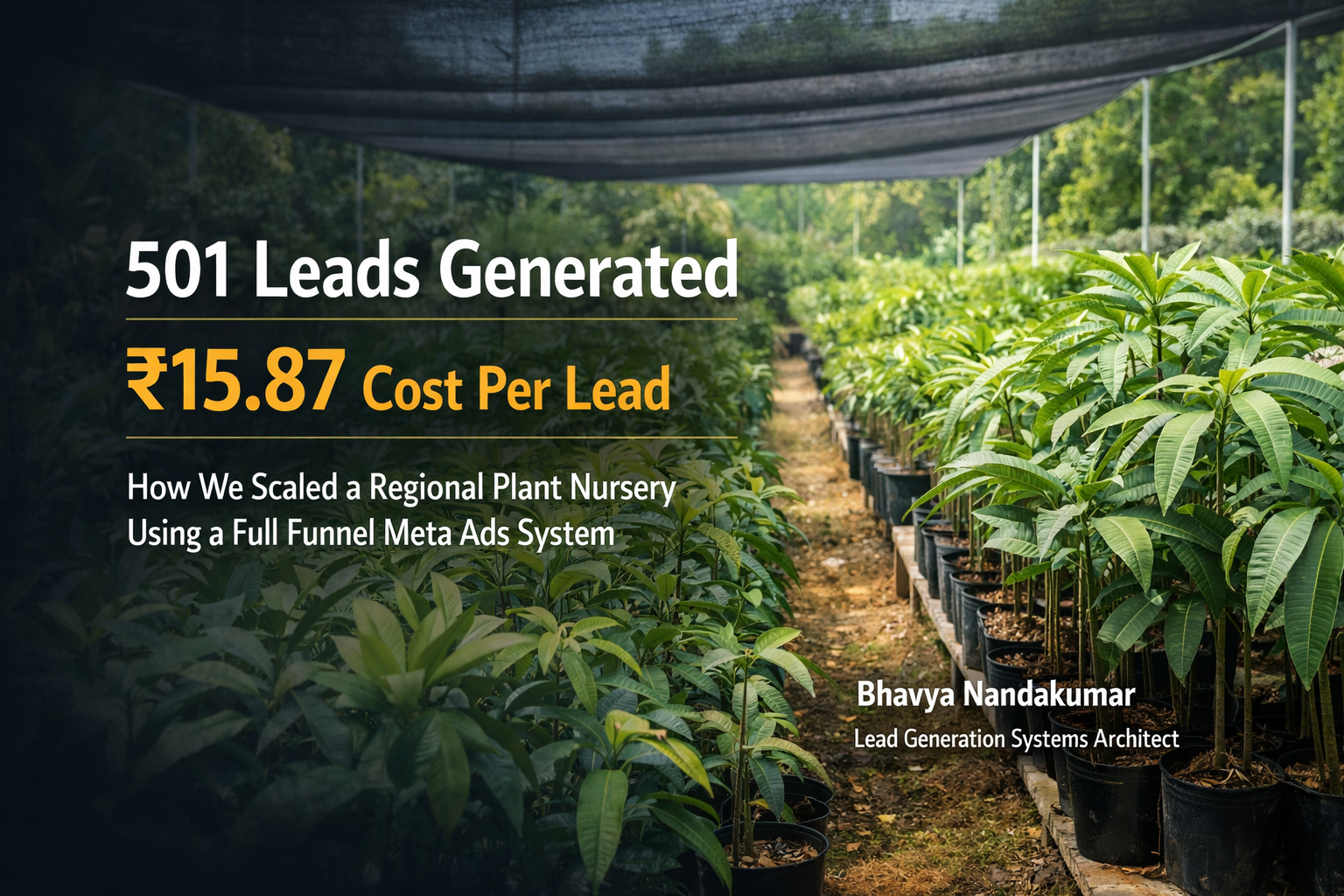
- 501 leads generated
- ₹15.87 average cost per lead
- Nearly 50,000 views
- 86% reach from non-followers
More importantly, the performance stabilized. Leads did not depend on aggressive budget increases or constant creative churn. The system began compounding.
Before diving into the architecture itself, it’s important to understand the context. Because what looks like a performance issue on the surface is often a structural design flaw underneath.
Most brands treat Meta ads as a channel.
The ones that scale treat them as an acquisition engine.
And an engine needs design.
The Industry Reality: Why Does It Seem Harder to Scale Meta Ads
Over the last few years, running Meta ads has become easier to launch — and harder to scale meta ads. In this case, the business was a regional tropical fruit nursery selling plant saplings and specialty fruit varieties directly to consumers. Unlike impulse-driven products, nursery purchases often involve research, seasonal timing, and trust. That makes structured funnel sequencing critical.
Ad platforms have simplified setup. Campaign objectives are clearer. Automation is stronger. Creative formats are more engaging.
But competition has intensified.
In most consumer categories today, brands are facing:
- Rising CPMs
- Shorter attention spans
- Faster creative fatigue
- Smarter competitors
- More ad noise
The barrier to entry has dropped. The barrier to sustained performance has not.
What this means in practical terms is simple: you cannot rely on one campaign type to drive consistent growth.
Yet that’s exactly what many brands do.
They launch direct-response lead ads to cold audiences and expect immediate scale. When it works initially, they double down. When performance declines, they try new audiences or increase budgets.
This creates a dangerous illusion.
Because early traction does not equal scalable architecture.
In competitive markets, cold lead ads often perform well for a limited window. The algorithm finds low-hanging fruit. Early adopters convert. Early momentum builds confidence.
But once that pool saturates, cost per lead rises. And without a structured funnel feeding warm audiences into the system, performance becomes unstable.
This was the exact scenario we observed.
The brand had active campaigns. Leads were coming in. But there was no compounding layer. No structured awareness engine. No sequencing logic. No intent amplification stage.
Every conversion campaign was starting from zero.
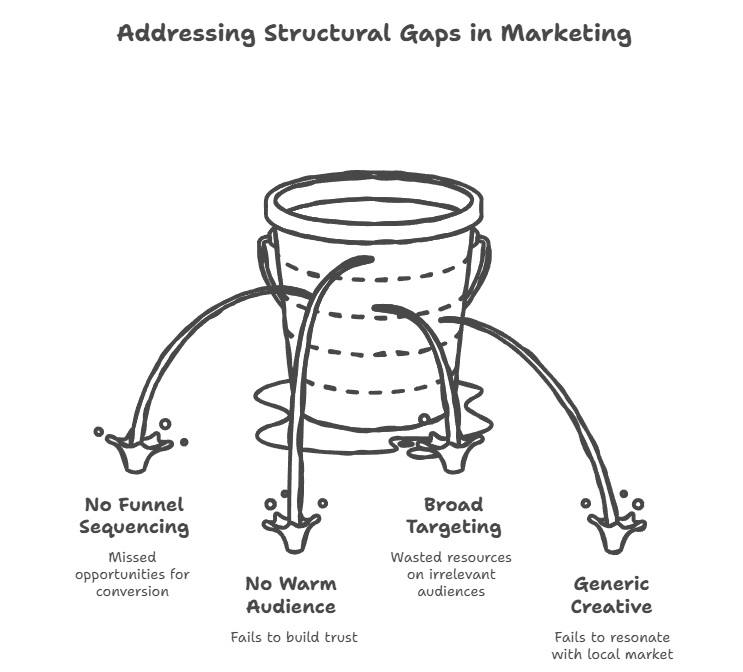
Imagine trying to fill a bucket without building a pipeline.
You can pour water repeatedly. But without structure, you cannot scale the flow.
This is where most Meta scaling attempts fail — not because the platform stops working, but because the acquisition system lacks layers.
To fix volatility, you must first identify where the structure is weak.
So before designing the new system, we diagnosed the underlying gaps that were limiting performance.
Diagnosing the Structural Gaps Before We Set To Scale Meta Ads
Before redesigning anything, we audited the acquisition flow as a system — not as isolated campaigns.
The goal was simple: identify where instability was being created.
Four structural gaps stood out immediately.
1. No Funnel Sequencing
All performance activity was concentrated at the bottom of the funnel.
Cold audiences were being shown lead ads directly. There was minimal investment in awareness or engagement-building campaigns. No deliberate effort to warm up prospects before asking for a commitment.
This works temporarily. It does not scale sustainably.
When cold traffic is pushed straight into a conversion event, cost per lead depends heavily on:
- Immediate intent
- Creative novelty
- Algorithmic luck
Once the easiest-to-convert users are exhausted, CPL increases.
Without funnel sequencing, there is no mechanism to rebuild intent pools continuously.
2. No Warm Audience Compounding
There was no structured retargeting logic beyond basic website visitors.
No segmentation based on:
- Video viewers
- Post engagers
- Profile interactions
- Multi-touch behavior
That meant two things:
First, the system wasn’t compounding.
Second, Meta had limited behavioral data to optimize intelligently.
Warm audiences are performance stabilizers. Without them, every campaign relies on cold discovery.
Cold discovery is expensive.
3. Broad Targeting Without Controlled Expansion
Like many brands today, the account relied heavily on broad targeting.
Broad targeting can work — but only when supported by:
- Strong creative testing
- Stable funnel sequencing
- High event density
In this case, broad audiences were being used without layered structure. Those amplified inefficiencies.
Instead of controlled expansion, the system was leaking budget across loosely qualified users.
Scaling without audience intelligence is gambling with ad spend.
For brands relying heavily on social platforms, automation and audience sequencing also play a major role in improving performance over time.
4. Generic Creative in a Regional Market
This was the most overlooked opportunity.
The brand operated in a region where local language and cultural cues significantly influence trust.
Yet most creatives were neutral and generic.
In high-trust purchase environments, relatability matters.
Attention is easier to earn when the message feels familiar.
Without cultural alignment, even technically sound campaigns struggle to maximize engagement velocity.
Once these structural gaps were clear, the path forward became obvious.
We didn’t need more campaigns.
We needed a layered lead generation system.
The Three-Layer Lead Stability Model To Scale Meta Ads
Instead of optimizing individual campaigns, we rebuilt the acquisition system from the ground up.
I call this the Three-Layer Lead Stability Model — a structured approach designed to create compounding demand, amplify intent, and stabilize conversions.
For a nursery selling products like mango, jackfruit, rambutan, and other fruit saplings, customers often need repeated exposure — they are not impulse buyers. This makes a structured funnel especially important.
The objective was not just lower CPL.
It was predictable performance.
Layer 1: Demand Creation Engine (Top of Funnel)
The first layer focused on building attention and engagement at scale.
Instead of pushing cold users directly into lead forms, we introduced short-form video and relatable creative built around real problems and local context. A strong emphasis was placed on vernacular messaging to improve familiarity and trust.
The goals at this stage were:
- Increase engagement velocity
- Build video viewer pools
- Expand profile interactions
- Grow warm retargeting audiences
We optimized primarily for reach, engagement, and video views — not leads.
This may feel counterintuitive to performance-driven founders. But without a strong awareness layer, bottom-funnel performance becomes fragile.
Demand must be created before it is captured.
Layer 2: Intent Amplification Engine (Middle of Funnel)
Once the awareness layer began building audience depth, we introduced structured retargeting.
Instead of treating all warm users the same, we segmented based on behavioral intensity:
- High video completion viewers
- Multi-post engagers
- Profile visitors
- Website visitors
Messaging evolved accordingly.
Creative at this stage shifted from storytelling to clarity:
- Product differentiation
- Objection handling
- Benefit reinforcement
- Social validation
This layer filtered curiosity into consideration.
Audience size decreased. Intent increased.
This transition is critical in full funnel lead generation strategy. Without intent amplification, warm audiences remain passive and under-optimized.
Layer 3: Conversion Stabilization Engine (Bottom of Funnel)
Only after warming and amplifying intent did we push aggressively for lead capture.
Conversion campaigns targeted exclusively warm or high-intent segments.
Optimizations included:
- Streamlined lead forms
- Reduced friction fields
- Clear, outcome-driven calls to action
Because the audience had already seen multiple touchpoints, resistance was lower. Trust was higher. Decision-making was faster.
This is where cost per lead stabilized at ₹15.87.
More importantly, performance stopped fluctuating dramatically with minor creative or budget adjustments.
The system began to behave like an engine — not a series of experiments.
But architecture alone is not enough.
Audience intelligence determines how efficiently that architecture performs.
If you’re unfamiliar with how different funnel layers work together, I’ve explained the step-by-step structure in this detailed breakdown of building a lead generation system.
The Audience Intelligence Framework
Once the funnel structure was in place, the next priority was tightening audience precision.
Many brands today default to broad targeting because Meta’s automation has improved. And in certain accounts, broad can perform well — especially when there is strong pixel data and high event volume.
But in this case, scaling required controlled expansion, not blind reach.
So instead of relying entirely on broad audiences, we built a structured interest-based targeting framework layered into the funnel.
Step 1: Controlled Interest Clusters
Rather than stacking multiple unrelated interests into one ad set, we grouped them into tightly aligned clusters based on:
- Category relevance
- Purchase behavior
- Competitor affinity
- Lifestyle alignment
Each cluster was tested independently.
This allowed us to identify:
- Which audience themes drove higher engagement
- Which segments produced lower CPL
- Which clusters responded better to vernacular creatives
Segmentation improved signal clarity. Clear signals improve optimization.
Step 2: Behavioral Stacking
Beyond interests, we layered behavioral indicators where relevant.
Instead of targeting broad interest audiences alone, we tested combinations such as:
- Interest + engaged shopper behavior
- Interest + recent interaction
- Interest + device-level alignment
This was not random layering. It was structured hypothesis testing.
The objective was to increase relevance without over-restricting scale.
Audience refinement should reduce waste — not choke delivery.
Step 3: Expansion Only After Stability
Scaling did not begin with budget increases.
It began with stability metrics.
We expanded audiences only when:
- Engagement rates were consistent
- Cost per lead stabilized
- Warm audience pools grew steadily
Once the funnel layers were feeding each other properly, controlled budget scaling became safe.
Without audience intelligence, budget expansion magnifies inefficiency.
With it, scaling becomes predictable.
At this point, the system had structural depth and audience precision.
But one layer still made a disproportionate impact on performance: cultural alignment.
The Vernacular Advantage: Cultural Alignment as a Performance Lever To Scale Meta Ads
One of the most underestimated variables in performance marketing is cultural alignment.
In regional markets, language is not just a communication tool. It is a trust signal.
When we introduced vernacular creatives into the top-of-funnel layer, the impact was immediate — not just on engagement, but on downstream performance.
Here’s why.
1. Higher Attention Velocity
In crowded feeds, familiarity increases thumb-stop probability.
When users encounter messaging in their primary language — especially in categories where trust influences purchase decisions — cognitive resistance drops.
Engagement rates improved because the creative felt native, not imported.
Higher engagement at the top of the funnel strengthened retargeting pools downstream.
2. Faster Trust Formation
Performance marketing often focuses heavily on targeting mechanics, but ignores psychological friction.
In this case, vernacular storytelling reduced perceived distance between brand and buyer.
The messaging felt closer.
More relatable.
Less transactional.
That reduced hesitation at the conversion stage.
Lower hesitation translates directly into lower CPL.
3. Stronger Warm Audience Quality
Because engagement quality improved, the warm audience pools became more responsive.
Retargeting audiences were not just larger. They were more qualified.
When we pushed bottom-funnel campaigns to these warmed segments, lead form completion rates improved without needing aggressive discounting or urgency tactics.
This reinforced a critical principle:
Creative alignment influences system efficiency.
Most brands treat creative as an aesthetic variable.
In reality, it is an architectural variable.
In high-trust or regionally nuanced markets, vernacular strategy is not optional. It is a performance multiplier.
With the funnel structured, audiences intelligently segmented, and creative aligned culturally, the system began to behave predictably.
Now let’s look at the performance outcomes — and what they actually indicate beyond surface-level metrics.
Results: From Volatile Performance to Predictable Lead Flow
Once the three-layer architecture, audience intelligence framework, and vernacular creative strategy were fully aligned, performance stabilized. The goal wasn’t just to generate leads, but to scale Meta ads without increasing volatility.
Over the campaign period, the system generated:
- 501 leads
- ₹15.87 average cost per lead
- ~49,947 total views
- 86% reach from non-followers
For a tropical fruit nursery, where purchasing decisions involve research, consideration, and trust, sustaining a ₹15.87 cost per lead and broad reach without discount-driven offers reflects a strong system-level strategy.
On paper, those numbers are strong.
But numbers alone don’t explain success.
The real outcome was structural stability.
Before the system redesign, performance depended heavily on constant campaign tweaks. Small creative changes could swing CPL. Budget increases created volatility. Results felt fragile.
After implementing the full funnel lead generation system:
- Warm audience pools compounded week over week
- Retargeting performance improved consistently
- CPL fluctuations reduced significantly
- Budget scaling became controlled rather than reactive
Instead of chasing performance, the system began generating it.
That is the difference between campaign execution and acquisition architecture.
When top-of-funnel demand creation feeds middle-of-funnel intent, and that intent feeds bottom-of-funnel conversion, performance becomes cyclical rather than episodic.
Cold traffic fuels engagement.
Engagement fuels retargeting.
Retargeting fuels conversion.
Conversion fuels data density.
Data density improves optimization.
That loop is what stabilizes ROAS.
Without it, scaling depends on temporary wins.
With it, scaling becomes systematic.
If you’re currently running Meta ads but struggling with unstable ROAS or rising CPL, you can book a structured Meta Ads Strategy Audit here.
What Founders Should Learn From This
If your Meta ads performance feels unstable, the problem is rarely just creative fatigue or audience saturation.
It is often one of three structural issues:
- You are pushing cold traffic directly into conversion.
- You are not building warm audiences intentionally.
- You are scaling budgets without strengthening funnel layers.
When ROAS drops after initial traction, founders often assume the platform has changed.
More often, the system underneath was never designed for scale.
Meta ads reward depth, sequencing, and behavioral signals.
They penalize randomness.
Scaling profitably is not about increasing budget.
It is about increasing structural integrity.
In the final section, I’ll answer common questions founders ask when their Meta ads stop scaling — and clarify what truly drives sustainable lead generation performance.
Frequently Asked Questions (FAQs)
Early traction usually comes from low-hanging demand. The algorithm quickly finds users with immediate intent.
But if there is no structured top-of-funnel layer building new engagement pools, performance declines once that initial demand is exhausted.
ROAS drops not because Meta stops working, but because the system stops feeding itself. If you want to scale Meta ads sustainably, the solution lies in system design, not ad duplication.
Short-term CPL reductions often come from creative swaps or temporary audience tweaks.
Sustainable CPL reduction comes from:
Building warm audiences consistently
Sequencing messaging across funnel stages
Improving audience relevance through structured targeting
Reducing friction at the conversion stage
When intent is nurtured before capture, cost per lead stabilizes. If you want to scale Meta ads sustainably, the solution lies in system design, not ad duplication.
Broad targeting can perform well in high-data accounts with strong creative testing and event volume.
But without structured funnel depth, broad expansion can amplify inefficiencies.
Interest-based targeting remains effective when:
Organized into clean clusters
Tested systematically
Expanded only after stability
Targeting is not about restriction. It is about signal clarity.
In regional markets, yes.
Language influences:
Attention
Relatability
Trust formation
Engagement velocity
Higher engagement at the awareness stage improves retargeting efficiency, which reduces downstream CPL.
Creative alignment directly affects system performance.
A full funnel lead generation strategy builds demand before attempting to capture it.
It includes:
Awareness campaigns to build audience pools
Consideration campaigns to amplify intent
Conversion campaigns targeting warmed segments
Instead of relying on cold lead ads alone, it creates a self-reinforcing acquisition loop.
This kind of structured Meta ads approach works exceptionally well for niche product businesses like regional nurseries, gardening brands, or consumer goods categories where decision-making is research-heavy rather than impulse-driven. It helps bridge awareness, consideration, and conversion phases that are typical in such buying cycles in your journey to scale meta ads.
Final Perspective
Meta ads are not inherently unstable.
What’s unstable is running them without architecture.
When brands treat paid acquisition as isolated campaigns, performance depends on constant intervention.
When brands treat paid acquisition as a layered lead generation system, performance compounds.
If you are investing in Meta ads but experiencing rising CPL, inconsistent ROAS, or scaling hesitation, the issue is unlikely to be solved with another campaign experiment. Brands that want to scale Meta ads must fix structure before expanding budget.
I work with founders and growth-focused brands to design full-funnel lead generation systems that create predictable acquisition engines — not temporary performance spikes.
If your current Meta setup feels reactive rather than scalable, a structured Scale Meta Ads audit is the right starting point.
About the Author
Hi, I’m Bhavya Nandakumar — a Lead Generation Expert and digital marketing strategist.
I work with founders and growth-focused brands that are already investing in Meta ads but struggling with unstable ROAS, rising cost per lead, or inconsistent scale.
Most of the brands I work with aren’t beginners. They have digital marketing teads. They’ve run campaigns. They’ve tested creatives. They’ve spent money. What they lack isn’t effort — it’s architecture.
My work focuses on designing full-funnel lead generation systems that create predictable acquisition engines. That means structuring demand creation, intent amplification, and conversion stabilization into a cohesive performance framework instead of relying on isolated campaigns.
Over the last 14+ years, I’ve worked across industries including healthcare, finance, consumer brands, and startups. I’ve seen firsthand how tactical execution without system design leads to volatility. And I’ve also seen how the right structure transforms performance from reactive to scalable.
I don’t believe in chasing ad hacks or copying trending formats. I believe in:
- Clear funnel sequencing
- Structured audience intelligence
- Cultural and psychological alignment
- Sustainable cost-per-lead optimization
- Performance stability before budget expansion
When you fix the system, scaling becomes logical.
Through consulting engagements, strategic audits, and performance architecture design, I help founders turn unstable Meta ads into structured, scalable lead generation systems.
If you’re spending on paid acquisition but unsure how to scale profitably, the problem is rarely another creative test. It’s usually structural.
If you want clarity on whether your current setup can scale — or what’s limiting it — you can book a one-on-one strategy audit with me here.
Because predictable growth is not accidental.
It’s engineered.


Leave a Reply